
Medical Billing Companies in USA: Market Guide, Pricing, and How to Shortlist
Medical billing companies in the USA fall into four tiers: solo billers and small local firms (typically 4–6% of collections), mid-size specialty firms (5–8%), enterprise RCM vendors (6–10% plus implementation fees), and EHR-bundled billing services (often 5–9%, tied to your software contract). The right tier depends on your claim volume, specialty complexity, and how much accountability you need from a named team.
Most guides to medical billing companies list the same generic advice: look for experience, check compliance, review reporting. That’s true and it’s useless — every vendor claims all three. This guide covers what actually differs between US billing companies: how they’re structured, where the work is performed, what they charge and why, what their contracts lock you into, and how to run a shortlist that surfaces the differences.
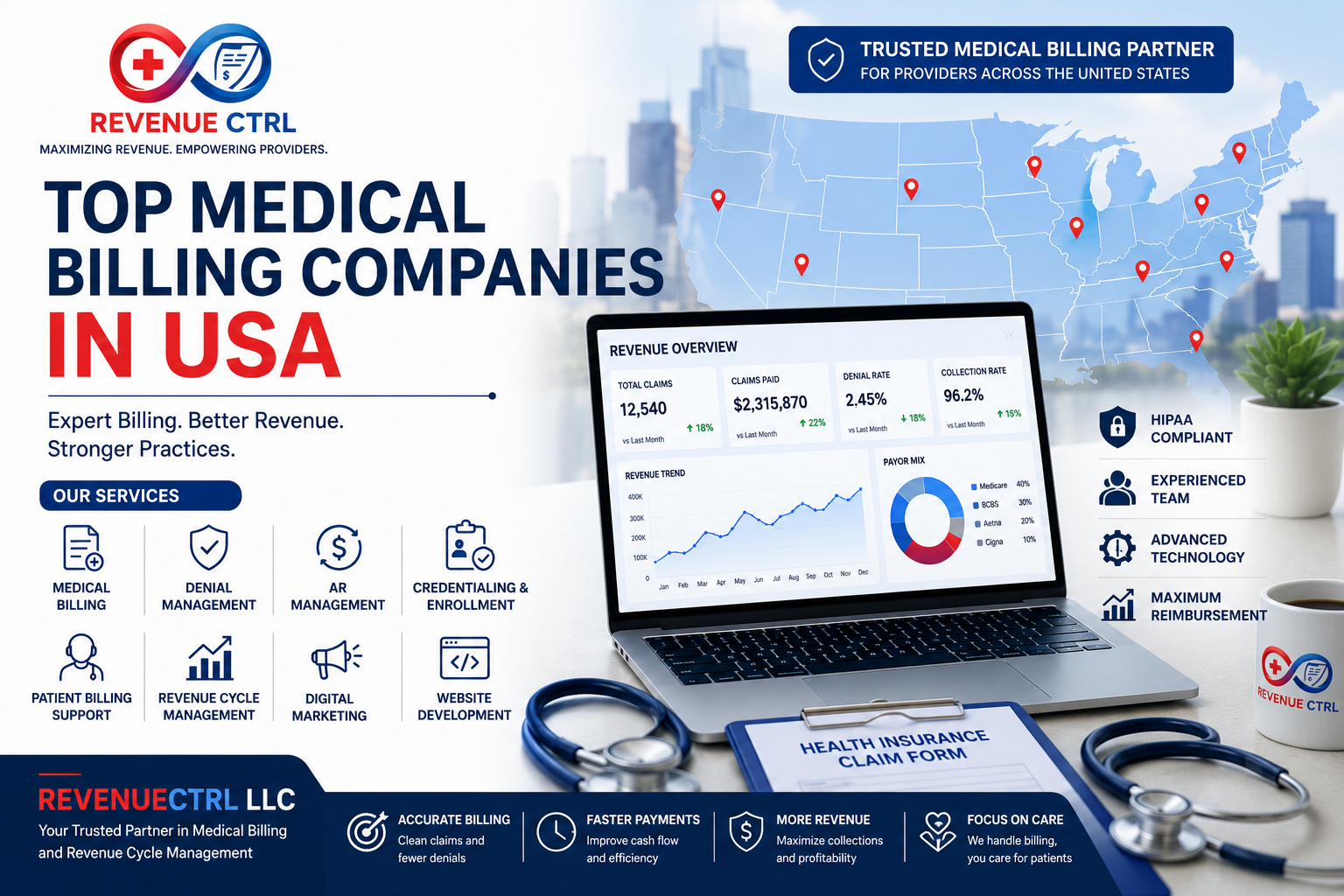
Revenuectrl LLC is a US-based medical billing and revenue cycle management company headquartered in Atlanta, Georgia. We’re writing this as an operator inside the market, and we’ll be direct about where we fit and where we don’t.
The Four Types of Medical Billing Companies in the USA
Understanding the tier you’re shopping in prevents most bad matches. A solo practice evaluating an enterprise vendor will be quoted for a scope it doesn’t need. A 12-provider group hiring a solo biller will outgrow them in a year.
1. Solo Billers and Small Local Firms
One to five people, often a former practice manager or certified coder who went independent. Usually 4–6% of collections.
Strength: Low cost, direct personal relationship, deep familiarity with one or two specialties. Weakness: Single point of failure. Illness, vacation, or resignation stops your cash flow. Limited technology, minimal reporting, and no capacity to work a large A/R backlog while also processing daily claims.
Fits: Single-provider practices under roughly 400 claims per month with simple payer mix.
2. Mid-Size Specialty Billing Firms
Ten to a hundred staff, often organized around specialty verticals. Typically 5–8% of collections.
Strength: Team coverage, specialty-trained coders, real claim-scrubbing technology, structured denial workflows, and account managers you can actually reach. Small enough that your practice matters to them. Weakness: Quality varies widely across this tier. Some are excellent; some are solo billers who scaled headcount without scaling process.
Fits: Most independent practices and groups, from 1 to 20 providers. This is where Revenuectrl LLC operates.
3. Enterprise RCM Vendors
National firms serving hospital systems and large groups. Typically 6–10% of collections, often with implementation fees, minimum monthly commitments, and multi-year terms.
Strength: Deep technology, analytics platforms, contract negotiation leverage with payers, and the scale to handle very high volume. Weakness: Small practices become account numbers. Support routes through ticket queues rather than a named person. Contracts are long and exits are expensive.
Fits: Multi-site groups, hospital-affiliated practices, and organizations over roughly 50 providers.
4. EHR-Bundled Billing Services
Billing offered by your EHR vendor as an add-on. Typically 5–9% of collections.
Strength: Native integration — no interface build, charges flow automatically from the chart. Weakness: Your billing and your clinical software become one contract. Switching billing means switching EHR, which is the most expensive change a practice can make. Service quality is rarely the vendor’s core competency.
Fits: Practices that highly value integration and are committed to their EHR long-term.
Onshore, Offshore, and Hybrid: What It Actually Means for Your Claims
This is the biggest structural difference between US medical billing companies, and most vendors are vague about it. Ask directly.
Fully onshore (US-based staff). Highest cost, easiest communication, simplest compliance story. Staff are in your time zone and can call payers during business hours without a handoff.
Fully offshore. Lowest cost, which is why some quotes come in dramatically below market. The tradeoff is usually payer follow-up: US payer phone queues operate in US business hours, and appeals often require live conversation. Offshore-only operations tend to be strong on data entry and weak on the human follow-up that recovers denied claims.
Hybrid. Data entry, charge posting, and payment posting handled offshore; coding, denial appeals, payer calls, and client communication handled onshore. This is the most common structure among mid-size US firms and generally the best cost-to-performance balance.
None of these is inherently wrong. What matters is that you know which one you’re buying, that a signed Business Associate Agreement covers every entity touching PHI, and that whoever calls payers on your behalf can actually reach them. Revenuectrl LLC runs US-based operations from Atlanta with a hybrid support structure, and we’ll tell you exactly which functions sit where.
What Medical Billing Companies in the USA Actually Do
Scope varies more than most practices realize. “Medical billing” from one vendor means claim submission only; from another it means the entire financial lifecycle. Confirm line by line.
| Function | Basic billing | Full RCM |
|---|---|---|
| Eligibility verification | Sometimes | Yes |
| Charge entry and coding | Yes | Yes |
| Claim scrubbing and submission | Yes | Yes |
| Payment posting | Yes | Yes |
| Denial appeals | Limited | Yes, with root-cause reporting |
| A/R follow-up | Often extra | Yes |
| Patient statements and calls | Often extra | Yes |
| Credentialing and enrollment | Rarely | Yes |
| Payer contract review | No | Sometimes |
| Analytics and monthly reporting | Basic | Dashboard access |
The gaps are where revenue leaks. A vendor that submits claims but doesn’t work denial appeals or aging A/R is leaving the hardest and most valuable work with you. Our full-service scope includes credentialing and enrollment and patient billing support so one team is accountable end to end.
How Much Do Medical Billing Companies in the USA Charge?
Three pricing models dominate the US market.
Percentage of collections (most common). Typically 4% to 10%, depending on tier, specialty complexity, claim volume, and scope. The vendor earns only when you get paid, which aligns incentives well. Watch for what the percentage is calculated on — it should be net collections received, not gross charges billed.
Per-claim flat fee. Usually a few dollars per claim. Predictable and often cheaper at very high volume with simple claims. The risk: the vendor is paid for submission, not collection, so there’s no built-in incentive to chase denials.
Flat monthly retainer. Fixed cost, easy to budget. Works for stable-volume practices, but if your volume grows the vendor’s incentive to keep up doesn’t grow with it.
The number that matters more than the rate
A practice billing $100,000 a month:
- Vendor A charges 5% and achieves a 92% net collection rate → collects $92,000, fee $4,600, net $87,400
- Vendor B charges 7% and achieves a 97% net collection rate → collects $97,000, fee $6,790, net $90,210
Vendor B costs more per dollar and delivers roughly $2,800 more per month — over $33,000 a year. Compare net collections after fees, never headline rates. Any credible vendor will model this for your practice before you sign.
Watch for these extras: setup and implementation fees, minimum monthly charges, per-statement patient billing fees, credentialing charged separately per provider per payer, clearinghouse fees passed through, and charges for custom reports.
Contract Terms: Where Practices Get Trapped
Pricing gets scrutiny. Contract terms rarely do, and they cause more regret.
- Term length. Multi-year lock-ins are common at the enterprise tier. If a vendor needs 36 months to prove value, that’s a statement about their confidence. Revenuectrl LLC works without long-term contracts.
- Termination notice. 30 days is reasonable. 90 to 180 days means half a year of a relationship you’ve decided to end.
- Data ownership and return. Your claims data and patient records are yours. The contract should state you get them back in a usable format at no charge. This clause is the one most often missing.
- Runout billing. After termination, who works the claims already submitted? Without a defined runout period, that revenue can simply go unworked.
- Performance standards. Strong contracts commit to metrics: clean claim rate, days in A/R, denial turnaround time. Most don’t. Ask for them in writing.
How to Build a Shortlist That Actually Surfaces Differences
Every vendor answers “do you have experience?” the same way. Ask questions that produce different answers:
- “What’s your clean claim rate, how do you calculate it, and will it appear in my monthly report?” Anything under 95% is below top-tier. Refusing to answer is disqualifying.
- “What are your current clients’ average days in A/R?” Under 40 is good; under 30 is excellent.
- “Where is each function performed, and who calls payers?” Establishes the onshore/offshore structure without a confrontation.
- “Show me a redacted sample of your monthly client report.” This reveals more than any sales deck.
- “Give me a reference in my specialty, at my size.” Not any client — a comparable one.
- “Model my net collections after your fee.” Separates operators from salespeople.
- “What’s the termination notice period and how is my data returned?” Read the answer against the actual contract.
For a full evaluation framework including red flags and a first-90-days timeline, see our guide to choosing the best medical billing company.
Specialties Where Choosing Correctly Matters Most
Some specialties have billing rules complex enough that a generalist vendor will underperform predictably:
- Behavioral and mental health — time-based codes, session limits, authorization requirements, telehealth modifiers
- Physical and occupational therapy — unit-based billing, the 8-minute rule, therapy caps
- Cardiology — bundling rules, global periods, high-value diagnostics
- Orthopedics and surgery — global surgical packages, assistant-surgeon modifiers, high-dollar claims where one error is costly
- Urgent care — payer-specific place-of-service rules and observation coding
- Pediatrics and family practice — high volume, immunization administration codes, well-visit bundling
Revenuectrl LLC’s deepest specialization is behavioral health, and we support family practice, cardiology, orthopedics, pediatrics, urgent care, physical therapy, and diagnostics. See our full specialties coverage.
Where Revenuectrl LLC Fits
We’re a mid-size, US-based firm in Atlanta serving practices nationwide. We are not the cheapest option and we’re not built for hospital systems. We’re built for independent practices and groups that want a named team, real reporting, and no contract holding them in place.
- 98% clean claim rate on first submission
- Under 30 days in A/R for clients after onboarding
- Live in 14 days from signed agreement
- No long-term contracts — month-to-month
- Full scope: billing, denials, A/R, credentialing, patient billing, plus healthcare digital marketing and web development
- Free 90-day claims audit before you commit to anything
If you’re a 40-provider multi-site group, an enterprise vendor may genuinely serve you better. If you’re an independent practice tired of being an account number, that’s who we built for.
Comparing billing companies? Start with your own numbers.
We’ll audit your last 90 days of claims and show you your real clean claim rate, days in A/R, and recoverable revenue — so you can compare vendors against a baseline instead of a sales pitch.
Most US medical billing companies charge 4% to 10% of net collections. Solo billers and small firms sit at 4–6%, mid-size specialty firms at 5–8%, and enterprise RCM vendors at 6–10% plus implementation fees. Per-claim flat fees and monthly retainers are less common alternatives. Compare net collections after fees rather than the headline rate.
A medical billing company handles coding, claim submission, and payment posting. A revenue cycle management (RCM) company covers the full financial lifecycle: credentialing, payer contracting, eligibility verification, billing, denial appeals, A/R follow-up, patient collections, and analytics. Many vendors use the terms interchangeably, so confirm scope function by function.
Offshore billing can be compliant when the vendor has a signed Business Associate Agreement covering every entity that touches PHI, uses encrypted systems with role-based access, and documents its data-handling policies. The practical concern is usually performance rather than security: US payer follow-up and appeals often require live phone contact during US business hours, which fully offshore teams handle less effectively.
A well-organized transition takes two to four weeks, covering system access, payer portal setup, EHR interface configuration, and workflow handoff. Revenuectrl LLC completes onboarding within 14 days and begins working existing A/R immediately. Confirm your current vendor’s runout billing terms before you give notice.
At least 95% on first submission. Top-tier firms operate at 95–98%. Revenuectrl LLC maintains a 98% clean claim rate by scrubbing every claim against payer-specific edits before submission. Any vendor that can’t state its clean claim rate and how it’s calculated should be removed from your shortlist.
Small practices are generally best served by mid-size specialty firms. Solo billers create a single point of failure — one resignation can freeze cash flow. Enterprise vendors treat small accounts as low priority and lock them into long contracts. A mid-size firm offers team coverage and specialty expertise while still providing a named account contact.
Yes. Revenuectrl LLC operates HIPAA-compliant encrypted billing systems, signs a Business Associate Agreement with every client, and runs US-based operations from Atlanta, Georgia.