Best Medical Billing Company in 2026: How to Choose the Right Partner for Your Practice
The best medical billing company is the one that measurably increases what your practice collects: a clean claim rate above 95%, days in A/R under 40, a documented denial-appeal process, HIPAA-compliant systems, transparent monthly reporting, and no long-term contract locking you in. Everything else — size, brand name, software — is secondary to those outcomes.
If you’re searching for the best medical billing company, you’re probably dealing with one of three problems: denials are climbing, your A/R is aging past 90 days, or your in-house biller just left, and you can’t afford another six-month learning curve. This guide walks through exactly how to evaluate a billing partner, what the top companies have in common, the red flags to avoid, and what you should expect in your first 90 days.
Revenuectrl LLC is a medical billing and revenue cycle management company based in Atlanta, Georgia, working with practices nationwide. We wrote this guide the way we’d want a client to evaluate us — with a checklist you can hold any vendor to, including us.
What Does a Medical Billing Company Actually Do?
A medical billing company takes over the financial side of patient care: translating clinical documentation into billable codes, submitting claims to payers, posting payments, following up on unpaid or denied claims, and billing patients for their portion. A full revenue cycle management (RCM) partner goes further, handling credentialing, payer contracting, eligibility verification, and analytics.
The difference matters. A basic billing service submits claims. A true RCM company owns the outcome — and reports on it.
Most practices that outsource do so for one reason: the math. An in-house biller costs salary, benefits, software, and training, and a single resignation can freeze cash flow for weeks. A billing company typically charges a percentage of collections, which means the company only earns more when you do.
8 Criteria That Define the Best Medical Billing Company
We’ve reviewed billing operations across behavioral health, primary care, cardiology, orthopedics, and urgent care. The top-performing companies share the same eight traits, in roughly this order of importance.
1. Clean Claim Rate of 95% or Higher
The clean claim rate is the percentage of claims accepted and paid on first submission without rework. It’s the single most predictive number for how a billing company will perform for you.
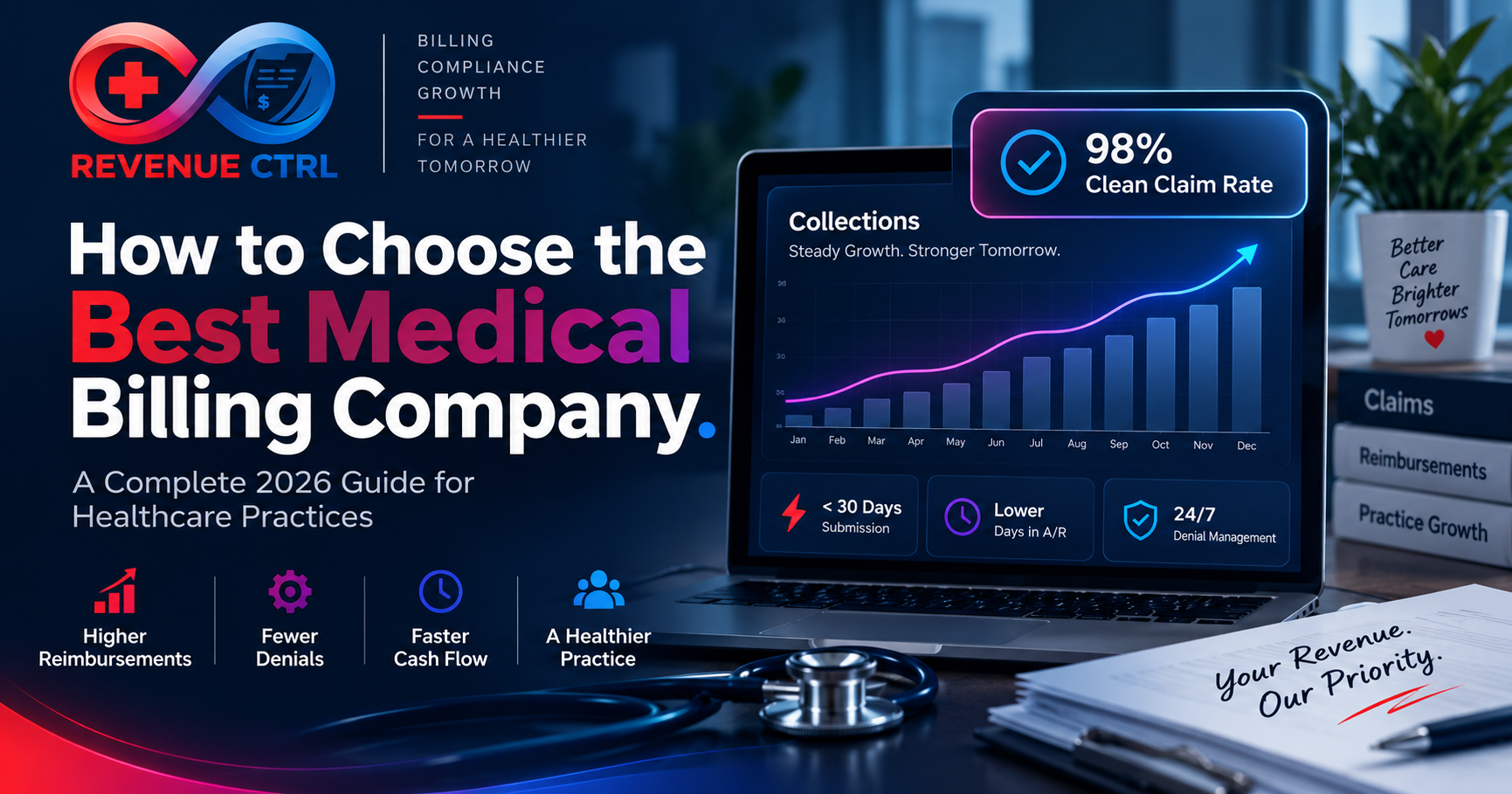
Industry benchmarks put the average somewhere in the low 90s. The best companies operate at 95–98%. Revenuectrl LLC maintains a 98% clean claim rate across managed practices because every claim is scrubbed against payer-specific rules before it leaves the queue.
Ask any vendor: “What is your clean claim rate, how do you calculate it, and can I see it in my monthly report?” If they can’t answer all three, move on.
2. Days in Accounts Receivable Under 40
Days in A/R measures how long it takes, on average, to get paid after a service is rendered. Anything over 50 days signals a follow-up problem. Anything over 90 means money is quietly expiring against timely filing limits.
The best medical billing companies run structured A/R management: claims are worked by age bucket, follow-up is scheduled rather than reactive, and nothing sits untouched for more than 14 days. After onboarding, our clients typically see days in A/R fall below 30.
3. A Documented Denial Management Process
Denials are unavoidable. Unworked denials are a choice. Roughly one in ten claims is denied on first submission across the industry, and a large share of those are never appealed — which is pure lost revenue.
Top billing companies treat denial management as a discipline with its own workflow: root-cause categorization, appeal templates by payer, deadline tracking, and a feedback loop that fixes the front-end error so the same denial doesn’t recur. Ask to see the process, not just the promise.
4. Specialty Expertise That Matches Your Practice
Billing rules vary dramatically by specialty. Behavioral health has time-based CPT codes, session limits, telehealth modifiers, and authorization requirements that a general biller routinely gets wrong. Cardiology has bundling and global-period rules. Orthopedics has high-dollar surgical claims where one coding error costs thousands.
The best medical billing company for your practice is one with a proven track record in your specialty. Revenuectrl LLC’s deepest expertise is in behavioral and mental health billing, and we support family medicine, cardiology, orthopedics, pediatrics, urgent care, physical therapy, and diagnostic centers with dedicated specialty workflows.
5. Credentialing and Payer Contracting Under the Same Roof
Billing problems often start before the first claim: a provider isn’t enrolled with a payer, a revalidation lapsed, or a contract was signed at a rate far below market. A billing company that also handles credentialing and enrollment and insurance contracting catches these issues early and keeps them from bleeding into your A/R.
Separate vendors for billing and credentialing usually means finger-pointing when a claim is denied for enrollment reasons. One accountable partner is simpler and faster.
6. HIPAA Compliance and Security You Can Verify
This is non-negotiable. The best companies use encrypted systems, role-based access, signed Business Associate Agreements, and documented data-handling policies. They should be able to explain where your data lives, who can see it, and how access is revoked when someone leaves.
If a vendor is vague about compliance, that vagueness will show up elsewhere too.
7. Transparent, Real-Time Reporting
You should never wonder what’s happening with your money. The best medical billing companies give you dashboard access and a clear monthly report covering charges, collections, adjustments, denial rate by reason, days in A/R, and aging by payer.
“No black box” is a principle we built Revenuectrl LLC around. Our clients see what we see. If a billing company only sends a lump-sum deposit summary, it’s hiding either the work or the results.
8. No Long-Term Contracts
A confident billing company doesn’t need a 24-month lock-in. It keeps clients by performing. Look for month-to-month or short-term agreements, clear termination terms, and a defined data hand-back process so you’re never held hostage to your own patient records.
Revenuectrl LLC works without long-term contracts. If we don’t deliver, you should be free to leave.
How the Best Medical Billing Companies Compare to In-House Billing
| Factor | In-House Biller | Best Medical Billing Company |
|---|---|---|
| Cost structure | Salary + benefits + software + training | Percentage of collections (pay for performance) |
| Coverage | One person; gaps during leave or turnover | Team coverage, no single point of failure |
| Specialty knowledge | Limited to that individual’s experience | Dedicated specialty workflows and payer intelligence |
| Denial follow-up | Often deprioritized under daily workload | Structured, deadline-tracked process |
| Reporting | Manual, inconsistent | Real-time dashboards, monthly analytics |
| Scalability | Hire again to grow | Scales with your volume automatically |
| Compliance | Depends on individual diligence | Documented policies, BAAs, audited systems |
In-house billing can work for a single-provider practice with low volume and a highly experienced biller. For most growing practices, the risk of turnover and the cost of missed denials outweigh the perceived control.
Red Flags: How to Spot a Bad Medical Billing Company
The wrong billing partner costs more than doing nothing. Watch for these warning signs during your evaluation:
- They won’t share a clean claim rate or days in A/R. Every real billing company tracks these. Refusing to share them means the numbers are bad or nobody’s watching.
- They quote a suspiciously low percentage. Rates far below market usually mean offshore-only teams with minimal follow-up. You’ll save on fees and lose on collections.
- Denials are “worked” but never categorized. If they can’t tell you your top five denial reasons, they aren’t fixing root causes.
- Contracts run 12–36 months with steep exit penalties. Performance should keep you, not paperwork.
- You can’t reach a real person. The best medical billing companies give you a named account contact and a response-time commitment. Ours is under four hours.
- They serve every industry. Generic “outsourcing” firms that also do IT support and call centers rarely have healthcare-depth coding knowledge.
- No mention of a Business Associate Agreement. If HIPAA isn’t discussed in the first conversation, walk away.
Not sure if your current biller passes the test? Find out in 90 seconds.
We’ll review your last 90 days of claims and show you your real clean claim rate, days in A/R, and exactly how much denied revenue is still recoverable — before it ages out.
What to Expect in Your First 90 Days With a Top Billing Company
A well-run transition should feel like relief, not disruption. Here’s the timeline the best medical billing companies follow, and what Revenuectrl LLC delivers:
Week 0 — Free revenue audit. Before any contract, a strong partner reviews your last 90 days of claims to identify denied, underpaid, and aging claims that are still recoverable. This is how you verify their expertise before paying a dollar.
Weeks 1–2 — Onboarding and setup. Secure system access, payer portal setup, workflow configuration, and a review of your fee schedule and credentialing status. Revenuectrl LLC completes onboarding and goes live within 14 days.
Days 15–45 — Claims execution and backlog recovery. New claims go out daily with pre-submission scrubbing. Simultaneously, the team works your existing A/R backlog, prioritizing claims closest to their timely filing deadline.
Days 45–90 — Denial reduction and optimization. With 30+ days of data, the partner should present your denial patterns and the front-end fixes that eliminate them, and you should already see days in A/R trending down.
Monthly — Reporting and strategy. A clear report, a call to walk through it, and specific recommendations. If a billing company goes quiet after onboarding, that’s a sign the relationship is transactional rather than accountable.
How Much Does the Best Medical Billing Company Cost?
Most billing companies charge between 4% and 10% of monthly collections, with the rate depending on specialty complexity, claim volume, and the scope of services (billing only versus full RCM with credentialing and patient billing). Some charge flat per-claim fees, typically for high-volume, low-complexity practices.
The right question isn’t “what’s the lowest rate?” It’s “what’s my net collection after fees?” A company charging 7% that collects 96% of what you bill puts far more money in your account than one charging 4% and collecting 85%.
Ask every vendor to model your expected net collections, not just their fee. Revenuectrl LLC provides this in the free audit so you can see the projected difference before deciding.
Why Practices Choose Revenuectrl LLC
We’ll be direct: we built this guide around the criteria we hold ourselves to. Here’s how Revenuectrl LLC measures against them.
- 98% clean claim rate on first submission across managed practices
- Under 30 days in A/R for clients after onboarding
- Behavioral health specialization with full support for primary care, cardiology, orthopedics, pediatrics, urgent care, physical therapy, and diagnostics
- Credentialing, contracting, billing, denials, A/R, and patient billing handled by one accountable team
- HIPAA-compliant systems with signed BAAs and secure, US-based operations in Atlanta, Georgia
- Real-time reporting with no black box — you see every claim, every denial, every dollar
- No long-term contracts and live within 14 days
- Free 90-day claims audit before you commit to anything
Beyond billing, we help practices grow with healthcare-specific web development, digital marketing, and AI automation — because a healthy revenue cycle is only half the picture if new patients aren’t finding you.
How to Make the Final Decision
Narrow your list to two or three candidates and run each through the same process:
- Request their clean claim rate, days in A/R, and denial rate in writing.
- Ask for a specialty-specific reference — a practice like yours, not just any client.
- Take the free audit. The quality of that analysis tells you exactly how they’ll work your claims.
- Read the contract for term length, exit terms, and data ownership.
- Confirm the BAA and security practices before sharing any patient data.
- Compare net collections, not fees.
The best medical billing company for your practice will pass all six without hesitation. Most won’t.
The best medical billing company for a small practice is one that offers month-to-month terms, specialty-specific expertise, a clean claim rate above 95%, and direct access to a named account contact. Small practices are most exposed to cash-flow gaps, so speed of onboarding and A/R follow-up matter more than brand size. Revenuectrl LLC onboards small practices in 14 days with no long-term contract.
Most medical billing companies charge 4% to 10% of monthly collections. The percentage depends on specialty, claim volume, and whether services include credentialing, denial management, and patient billing. Always evaluate net collections after fees rather than the fee alone.
A top medical billing company should maintain a clean claim rate of at least 95%. The industry average is lower. Revenuectrl LLC operates at 98% by scrubbing every claim against payer-specific rules before submission.
Outsourcing typically makes sense when denials exceed 8–10%, days in A/R exceed 45, your in-house biller lacks specialty expertise, or turnover is putting cash flow at risk. In-house billing can work for a very low-volume practice with an experienced, stable biller.
Medical billing covers coding, claim submission, and payment posting. Revenue cycle management (RCM) covers the full financial lifecycle: credentialing, payer contracting, eligibility, billing, denials, A/R, patient collections, and analytics. The best companies deliver full RCM so one team is accountable for the outcome.
A well-organized transition takes two to four weeks. Revenuectrl LLC completes onboarding within 14 days, including system access, payer setup, and workflow configuration, while beginning to work existing A/R immediately.
Yes. Revenuectrl LLC operates HIPAA-compliant, encrypted billing systems, signs a Business Associate Agreement with every client, and runs US-based operations from Atlanta, Georgia.
Find Out What Your Practice Is Leaving on the Table
Every day a claim ages, it gets harder to collect. If you’re comparing medical billing companies, start with the audit that shows you real numbers: we’ll review your last 90 days of claims and show you what’s still recoverable, what it’s worth, and what’s already gone.
Book Your Free 90-Day Claims Audit or call +1 770-520-0840. No obligation, no long-term contract, HIPAA compliant from day one.