
Professional vs Institutional Claims: CMS-1500 vs UB-04 Explained
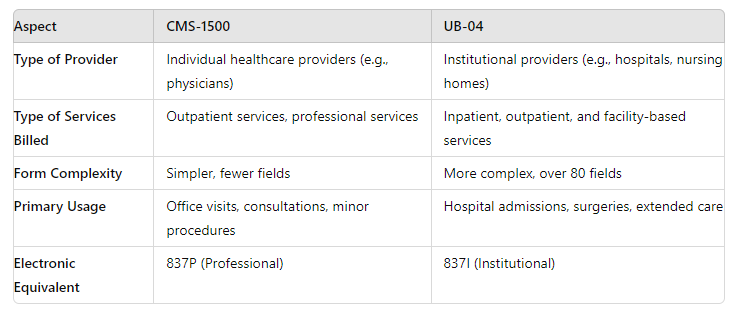
Professional claims bill for a provider’s individual services on the CMS-1500 form (electronically, the 837P transaction). Institutional claims bill for a facility’s resources — room, equipment, supplies, nursing — on the UB-04 form (electronically, the 837I). The key point most explanations miss: a single hospital encounter usually generates both, one from the physician and one from the facility.
That split is the source of most confusion in this topic. Professional claims are not “outpatient only.” A surgeon operating on a hospital inpatient submits a professional claim with place of service 21 while the hospital submits its own institutional claim for the same admission. Two claims, two payers’ processing paths, two very different payment methodologies, one patient encounter.
This guide covers what actually differs between the two claim types: the forms, the EDI transactions, the data elements, how each is paid, and the split-billing scenarios that cause denials when handled incorrectly.
What Is a Professional Claim?
A professional claim bills for the work of an individual provider — the clinical judgment, the procedure performed, the interpretation rendered.
Who submits it: physicians, nurse practitioners, physician assistants, physical and occupational therapists, behavioral health clinicians, chiropractors, independent labs and imaging centers, ambulance services, and durable medical equipment suppliers.
Where the service can occur: anywhere. Office (POS 11), patient home (POS 12), inpatient hospital (POS 21), outpatient hospital (POS 22), emergency room (POS 23), skilled nursing facility (POS 31), telehealth (POS 02 or 10). The setting does not determine whether a claim is professional — who is billing and for what does.
Form: CMS-1500 (paper) / 837P (electronic)
Core data elements:
- CPT and HCPCS procedure codes
- ICD-10-CM diagnosis codes
- Modifiers (25, 59, 26, TC, LT/RT, and others)
- Units
- Place of service code
- Rendering provider NPI and billing provider NPI
- Referring provider where required
How it’s paid: typically on a fee schedule — a set allowable per CPT code, adjusted by geography and modifiers. Medicare uses the Physician Fee Schedule with RVUs.
What Is an Institutional Claim?
An institutional claim bills for a facility’s resources consumed during care — the bed, the operating room, nursing hours, supplies, drugs, equipment time.
Who submits it: hospitals (inpatient and outpatient), skilled nursing facilities, home health agencies, hospices, rehabilitation facilities, critical access hospitals, dialysis centers, and hospital-based clinics.
Form: UB-04, also called CMS-1450 (paper) / 837I (electronic)
Core data elements the CMS-1500 doesn’t have:
- Revenue codes — four-digit codes identifying the department or cost center (0450 emergency room, 0300 laboratory, 0360 operating room, 0120 semi-private room). This is the defining UB-04 field and has no CMS-1500 equivalent.
- Type of bill (TOB) — a three-digit code stating facility type, bill classification, and frequency
- Admission and discharge dates, admission type, admission source, discharge status
- Condition, occurrence, and value codes
- Attending, operating, and referring provider fields
- Plus CPT/HCPCS and ICD-10-CM codes, and ICD-10-PCS procedure codes for inpatient claims
How it’s paid: varies by setting and is rarely a simple fee schedule.
- Inpatient: usually DRG (Diagnosis-Related Group) — a bundled payment for the entire admission based on diagnosis, procedures, and severity. Length of stay doesn’t directly change the payment.
- Outpatient: often APC (Ambulatory Payment Classification) under Medicare’s OPPS
- Skilled nursing, home health, hospice: their own prospective payment systems
This payment difference is the practical heart of the distinction. A professional claim is paid per service. An inpatient institutional claim is paid per admission, as a bundle.
Professional vs Institutional Claims: Full Comparison
| Professional Claim | Institutional Claim | |
|---|---|---|
| Bills for | The provider’s individual work | The facility’s resources |
| Paper form | CMS-1500 | UB-04 (CMS-1450) |
| EDI transaction | 837P | 837I |
| Submitted by | Physicians, therapists, clinicians, labs, DME | Hospitals, SNFs, home health, hospice, rehab |
| Settings | Any — office, home, inpatient, outpatient, telehealth | Facility settings only |
| Care type | Inpatient and outpatient | Inpatient and outpatient |
| Procedure codes | CPT / HCPCS | CPT / HCPCS, plus ICD-10-PCS on inpatient |
| Revenue codes | Not used | Required — core field |
| Type of bill | Not used | Required |
| Place of service | Required | Not used (type of bill serves this role) |
| Provider identifier | Rendering provider NPI | Facility NPI, plus attending and operating providers |
| Payment method | Fee schedule (RVU-based for Medicare) | DRG inpatient, APC outpatient, or PPS by setting |
| Typical complexity | Moderate | High — more required fields, more edits |
Note the two rows that correct a common misunderstanding: care type is inpatient and outpatient for both, and place of service is a professional-claim field that doesn’t exist on the UB-04.
When One Encounter Generates Both Claims
This is where billing errors concentrate. Common split-billing scenarios:
Hospital inpatient admission. The hospital bills the facility charges on a UB-04 under DRG. Each physician involved — attending, surgeon, anesthesiologist, consulting specialists, radiologist, pathologist — bills professionally on a CMS-1500 with POS 21. A ten-day admission with four consulting physicians produces one institutional claim and five or more professional claims.
Emergency department visit. The hospital bills the ED facility fee on a UB-04 with revenue code 0450. The emergency physician bills the professional E/M on a CMS-1500 with POS 23. Patients receiving two bills for one ER visit is the most common source of patient billing confusion, and a frequent patient billing support issue.
Hospital-based imaging. An MRI performed at a hospital generates an institutional claim for the technical component — the machine, the technologist, the facility — and a professional claim from the radiologist for the interpretation, billed with modifier 26.
Provider-based clinics. A clinic owned by a hospital system bills the facility component institutionally and the physician component professionally, even though the patient experiences it as an ordinary office visit.
Professional and technical components: modifiers 26 and TC
Certain services — imaging, EKGs, pathology — have two payable parts:
- Modifier 26 (professional component) — the interpretation and written report, billed by the physician on a CMS-1500
- Modifier TC (technical component) — the equipment, supplies, and technician, billed by whoever owns the equipment
- Global (no modifier) — one entity owns both parts, as when an independent office performs and reads its own X-ray
Where this goes wrong: billing globally when the facility owns the equipment. The payer pays the technical portion to the facility and denies or recoups yours. Conversely, billing only modifier 26 when you own the equipment leaves the technical payment unclaimed. This is a recurring root cause we see in denial management reviews.
Common Errors and How They Denied
| Error | What happens | Fix |
|---|---|---|
| Wrong form entirely (CMS-1500 for facility charges) | Rejected at the clearinghouse or denied outright | Determine the billing entity first, then the form follows |
| Missing or invalid revenue code on a UB-04 | Claim rejected before adjudication | Map every charge line to its department revenue code |
| Wrong type of bill | Routed to wrong processing path; denial | Verify facility type, classification, and frequency digits |
| Billing global when the facility owns equipment | Denial or recoupment of the technical portion | Confirm equipment ownership before applying 26 vs TC vs global |
| Missing modifier 26 on a hospital-setting interpretation | Underpayment or denial | Default to 26 for reads performed on facility equipment |
| Wrong place of service on a professional inpatient claim | Paid at the facility rate instead of the correct one, or denied | POS 21 for inpatient, 22 outpatient, 23 ER |
| Mismatched dates between professional and institutional claims | Payer flags the encounter for review | Reconcile DOS against the admission record |
| Provider not enrolled for the facility setting | Enrollment denial | Verify credentialing and enrollment covers the setting and location |
Most of these trace back to a decision made at charge entry — wrong form, wrong modifier, wrong POS — which is where they’re cheapest to catch.
How to Determine Which Claim Type Applies
Three questions, in order:
- Who is the billing entity? An individual provider or provider group bills professionally. A facility bills institutionally. This determines the form regardless of where the service happened.
- What is being billed — work or resources? Clinical judgment, procedures, and interpretations are professional. Room, board, nursing, equipment time, and supplies are institutional.
- Does the service have separable components? If it’s imaging, pathology, or a diagnostic study performed on someone else’s equipment, apply modifier 26 and expect a separate technical claim from the facility.
If both a provider and a facility contributed, expect two claims. That’s normal, not an error.
Which Practices Need to Handle Both?
Practices that bill only professional claims: independent physician offices, private therapy and behavioral health practices, freestanding clinics.
Practices that deal with both: hospital-employed physician groups, ambulatory surgery centers, hospital-affiliated specialty practices, provider-based clinics, and any practice whose physicians round on inpatients.
Billing both claim types correctly? Let’s check the numbers.
Our free 90-day claims audit reviews your professional and institutional submissions for form, modifier, and place-of-service errors — and identifies the denials and underpayments still recoverable.
If your practice touches both, the operational requirement is a billing team fluent in both form sets and both payment methodologies. They behave differently enough — revenue codes, DRG bundling, type of bill — that experience with one does not transfer automatically to the other. Revenuectrl LLC handles both claim types across our medical billing and revenue cycle management services, with A/R follow-up that accounts for the different appeal paths each type takes.
Professional claims bill for an individual provider’s services using the CMS-1500 form (837P electronically) and are paid on a fee schedule. Institutional claims bill for a facility’s resources using the UB-04 form (837I electronically) and are paid by DRG for inpatient or APC for outpatient. A single hospital encounter commonly generates both.
The CMS-1500 is the professional claim form used by individual providers; it includes place of service, rendering provider NPI, and CPT codes with modifiers. The UB-04 (also called CMS-1450) is the institutional form used by facilities; it adds revenue codes, type of bill, admission and discharge data, and condition, occurrence, and value codes that the CMS-1500 does not have.
No. Professional claims are submitted for services in any setting, including inpatient. When a physician treats a hospital inpatient, the physician bills a professional claim on a CMS-1500 with place of service 21 while the hospital separately bills its institutional claim on a UB-04 for the same admission.
Both are HIPAA-standard electronic claim transactions. The 837P is the electronic equivalent of the CMS-1500 professional claim. The 837I is the electronic equivalent of the UB-04 institutional claim and carries additional segments for revenue codes, type of bill, and admission data. Nearly all claims are submitted electronically rather than on paper.
Because the visit generated both a professional and an institutional claim. The facility bills for the room, equipment, and nursing, while each physician who treated you bills separately for their professional services. An emergency room visit, for example, typically produces a hospital facility bill and a separate emergency physician bill.
Revenue codes are four-digit codes identifying the hospital department or cost center associated with a charge, such as 0450 for emergency room or 0360 for operating room. They are required on institutional UB-04 claims and are not used on professional CMS-1500 claims.
Modifier 26 identifies the professional component — the physician’s interpretation and report — and is billed on a professional claim. Modifier TC identifies the technical component: equipment, supplies, and technician time, billed by whoever owns the equipment. When one entity provides both, the service is billed globally with no modifier. Billing globally when a facility owns the equipment causes denials or recoupment.